Tuesday, February 4, 2014

MTM Part 3


Temples everywhere. Monkey's everywhere. The monkeys love bananas, as do the temple elephants - who also like sugar cane. The locals bring these and coconuts to the temple with their flowers and leave them as offerings to the gods. Nothing goes to waste, with the monks accepting food as well as money to help Hindus on their way to Nirvana.


 Looking up at the 1000 steps we have to climb to the temple
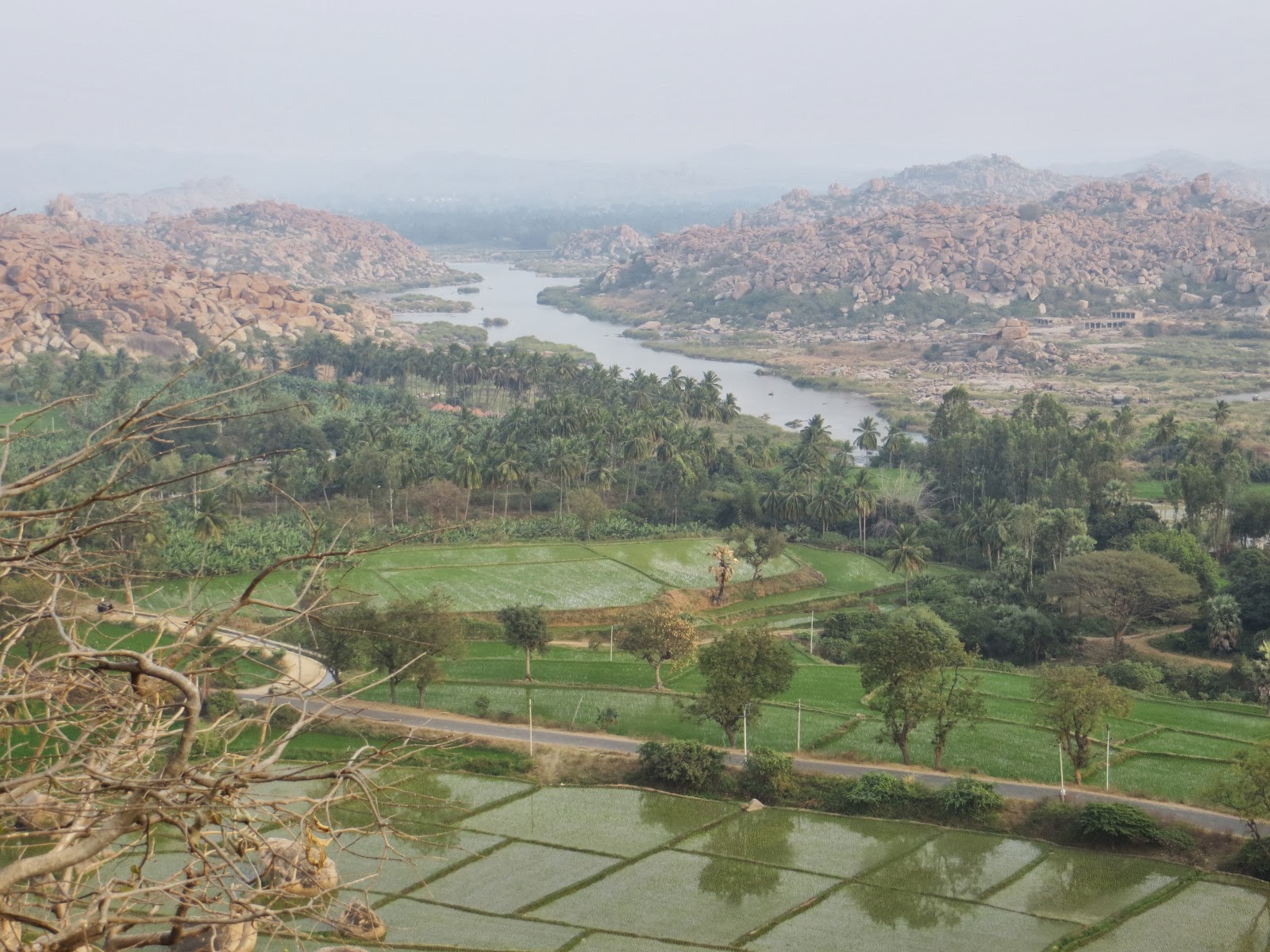


The panoramic view once we climbed the steps :)


Murray breathes in love and breathes out peace once he reaches the top...

Langler Monkeys - note the LONG tails...

Main Hindu temple in Hampi still in use (circa 1300's) taken from the older temple complex (circa 600's). The city had around 500,000 residents in it's hay day as a strategic trading post on the spice route.


Temple elephant enjoys offerings of sugar cane and bananas. He much preferred the sugar cane and let the monkeys steal the bananas.


 Monkey business!!


Thursday, January 30, 2014

MTM Part 2

The Mysore markets specialise in fruit and veg and flowers. The smell was fresh and delicious. We spent hours wandering up and down the isles. I've been wearing fresh flowers in my hair for the last week as the locals do. Every so often you get a wiff of jasmine or rose and it insulates you from all the dung and rot. When I first stated doing it, one of the girls kept saying "Oh that's a lovely incense I can smell" - It was fun to tell her it was me she could smell :)

The flowers are cleverly strung on metres and metres of string and sold bulk to then be made into offerings that people buy to take to the temple. Marigolds of every hue, roses of every colour, jasmine still attracting bees all carefully wound so nothing falls out and they can be cut at any point and not unravel. No knots.


 Marigolds by the tonne
 Flowers woven for use as offerings
 Large offerings for sale
 Sacks of roses
 100's of metres of marigolds
By the kilo
My daily head gear

MTM - Monkeys Temples, Markets (and a Palace)

We stopped in Mysore specially to see the Palace. I had no expectations what would be at the Palace - seen plenty through the trip... Oh my goodness! I walked around a corner into the main chamber and had to close my gaping jaw! Unfortunately no photos allowed inside but we bought some postcards and I've included a couple of scans here. Doesn't do the place justice. If I had been living here you would have had to drag me out screaming, before I would give it up. Intricate stained glass of peacocks in all their beautiful green/blue hues, souring ceilings held up by massive cast iron pillars painted in turquoise blue and gold leaf, finely carved teak doors and ceilings, walls painted with murals of the kings expeditions and expositions, rooms commonly 20m x 120m...

 Silver door (sorry can't seem to rotate the pic)
 The central chamber with stained glass peacock ceiling
 Decorative pillar work
 Large rooms...

Traditional Indian Theatre best understood through 'Ballet'


 Went to a theatre production of one of the core Hindu 'parables' or stories. The entire story was enacted through body language especially facial and upper body movements. Amazing! We had no idea except for a short English synopsis what it was about but the four players brought the entire story to light. And their costuming and makeup were incredible. We even got to watch them 'do' their make up prior to the show. Best way to describe how we approached the show was like going to ballet in our world.


Go Girls!

Like most cultures little is recorded formally about the lives of the women.

I was lucky enough in Kochi to visit a palace that had a substantial display on the women of Kerala State. Kerala is the only Indian state to have been ruled by a maternal line of royalty. So the ruling son got the job through his mother. The next king would be the son of his mother's eldest daughter. The mother of the king was often also the treasurer of the kingdom - putting her in a very powerful position in allocating 'government' spending.

It was only when the maternal line ran out they were forced to have mass adoptions from other areas and during these times the politics were unstable. The British took advantage of one of these periods to conquer the state. However, Kerala was also the first state to volunteer to join the Indian Union at Independence.  And as I have said before Kerala has the best living conditions in India - a product of their heritage? The question must be asked...

One of the thing that happened when the British were trying to unstabilise the area was they encouraged the men to be rebellious about having the matriarchal line. With the British behind them, the locals changed the power base under the British to be through the men and it has remained since early 1900's.

The display had lots of early photos and the first thing that caught my eye was the women were wearing sarong style clothes - without any shoulder covering. On closer inspection we realised the more powerful women were bare chested in the photos. It seems until the mid 1800's all women wore dhotis (Indian sarongs worn at the waist) and only for ceremonies did they add a second piece of fabric to cover their breasts (just held losely under their arms). Thus the photos until around 1920's often had bare chested women. And the fashion style once the upper garment became common was a loose blouse without any scarf or head cover. It wasn't till the 1970's the women started to wear the sari in the north Indian fashion. I wonder of the advent of cinema and Bollywood was a driver of this change?

Sunday, January 26, 2014

Peaceful Kerala Part Two Updated 5/2/14


We were lucky enough to have two boat rides through the waterways - 1 in a small ferry like vessel from the mainland and another in a poled canoe through the small canals looking at plant and bird life and watching the world of the locals slide by.


Our 'big' boat that transferred us from the mainland to our home stay.


One of the 100's of house boats available for hire to cruise the waterways at your leisure. There are literally 100's of these, of varying size and quality, and it must be a traffic jam when they all hit the water in high season... :(


A peculiarity of the region - the use of umbrellas in the sun, by both men and women. I was surprised to see the boat captains not wearing hats or rigging up permanent shade for their wheel houses.

Housing is right on the water
Quiet waterways form the irrigation network for rice paddies as far as the eye can see...
Foot bridges join the islands and dykes together

 A bit too peaceful...

 Our wooden pole boat

Tour leader Sam enjoys the compulsory chai in a relaxing moment

Water hyacinth

Red water lilies almost open

Poling through the canals

Those rice paddies...

Palm trees support the canal banks against erosion

Locals go about their business in the late afternoon

A swimming lesson

Those rice paddies take a lot of loving labour and water to produce the local economic staple

Men off to work

Local wildlife - forgotten the name...

 
Sunset completes a beautiful afternoon

Quiet canals reveal welcoming homestay Part One

Jumping on a small boat after a train ride from Varkala we entered the canals and waterways of Kerala Backwaters. This series of lakes, rivers and canals primarily provide irrigation for the rice crops grow here for the last few hundred years but also provide a lifestyle, food and mode of transport for the residents (about 2000 people - tiny for India). The dykes and levees were completed in 1904.

It is a quiet, peaceful place with wildlife and shy, friendly people. We were hosted in a Home Stay by a retired couple Lola and 'Mr Lola'. She was a pharmacist and him a banker. One son is studying in Melbourne and the other in India.  Lola is an amazing cook and we had beautiful food while there -eg. coconut pancakes (dosa) and steamed bananas for breakfast :)

The Scullery including wood stove on left, stone spice grinder (back centre), sink (centre) and coconut grater far right. The gas hotplate and a work bench about 4 metees long was in the main kitchen. 

Cooking the Dosa (wheat flour, egg white, sugar and coconut milk) and preparing the coconut filling (freshly grated coconut, sugar, cardomom)

 Taking the steamed bananas out of the pressure cooker with Mr Lola looking on. He must drive her nuts now he's retired and around the house all the time ;)

 Front of the house looking from the water as we left. We had bedrooms on the top floor.
 

We were lucky enough to have two boat rides through the waterways - 1 in a small ferry like vessel from the mainland and another in a poled canoe through the small canals looking at plant and bird life and watching the world of the locals slide by.